The short version
- Production-readiness for agents is not model quality; it is the layers around the model: validation, scopes, confirmation gates, limits, audit, and fallbacks.
- Design confirmation by consequence: reversible writes get a human yes; destructive writes demand the strongest yes your client supports, with no model-provided fallback flag accepted.
- The case study: a confirmWrite gate on every mutating tool of an events platform — approval cards where the client supports them, an explicit second-call confirm where it doesn't, destructive deletes that refuse anything less than the card, and product rules that stay locked even after a human says yes.
Every agent demo ends the same way: the model books the meeting, files the ticket, publishes the thing, and the room applauds. Production begins where the demo ends — at the first write the user did not want. An assistant that can create an event is useful until it publishes one the host never read; an agent that can clean up records is useful until it cleans up the wrong ones. The difference between those two states is not a better model. It is architecture.
This guide covers the guardrail stack that makes agents shippable: the six layers, how to design confirmation flows that respect both safety and usability, the actions that should stay impossible regardless of approval, and the concrete gate system I built for AI-driven writes on a production events platform.
What "production-ready" actually means for an agent
A production-ready agent is one whose worst plausible action is acceptable. Not its average action — its worst: the model misreads intent, a user phrases something ambiguously, a retry fires twice, a prompt injection asks the agent to do something hostile. Readiness means each of those resolves into a bounded, visible, recoverable outcome.
That property is built from layers, none of which involve the model getting smarter:
Six layers between a demo and production
Input validation
Schemas on every entry point. An agent that accepts any JSON will eventually send any JSON.
Scopes & permissions
The agent holds a key with explicit scopes, not an admin session. Capability is the key, not the prompt.
Confirmation gates
Writes wait for a human yes. Destructive writes demand the strongest form of yes your client supports.
Rate limits & budgets
Per-caller limits and spend alarms. A loop of tool calls should hit a wall, not a credit card.
Audit & observability
Log every tool call with who, what, and outcome. “The model did it” must resolve to a trace.
Fallbacks & kill switch
Authored responses for provider failure, and a flag that turns the agent off without a deploy.
Two of those layers do the heaviest lifting for agents that write, and they deserve their own sections: confirmation gates and the human-in-the-loop design around them.
How you should design confirmation
Classify writes by consequence, not by endpoint
Sort every mutating action your agent can take into three buckets:
- Reversible writes — create a draft, update a field you can change back. Gate: a human yes.
- Hard-to-reverse writes — publish something public, send a message, charge a card. Gate: a human yes with the full details displayed before the action.
- Destructive writes — delete records, cancel with side effects. Gate: the strongest confirmation your platform supports, and refusal when that strongest form is unavailable.
The classification is product work, not engineering work — do it in a meeting with the people who own the data, and write it down. Every future tool gets sorted into the list before it ships.
Make the yes explicit, attributable, and fresh
A confirmation is only real if it satisfies three tests. Explicit: the user approved this action with these details — "create 'Birthday dinner' on March 12 with 20 spots?" — not a general "go ahead" three turns ago. Attributable: the yes came from the human, through UI the human controls (an approval card, a button), not from the model asserting the human agreed. Fresh: approval covers one action now; it does not persist as a license for similar actions later.
That third test kills the tempting shortcut of a confirmed: true parameter on the tool — because the model can, and will, set it unprompted. If your client can render an approval card (MCP elicitation, a UI button), that card is the yes. If it cannot, the acceptable fallback is a two-call protocol: the first call returns without writing and instructs the model to state the action to the user and call again with the explicit flag — the flag is evidence of a stated intention, not a silent default. And for destructive writes, no fallback: no card, no delete.
Keep some actions impossible — even after a yes
Confirmation gates catch unwanted actions. A second class of protections must hold even when the human does say yes: domain rules the agent is never allowed to route around. Policies that lock after a point of no return, conversions that cannot be undone, workarounds that technically satisfy a request by destroying something (delete-and-recreate to escape a locked setting). These belong in the API as refusals, with the agent instructed to explain them rather than engineer around them. A guardrail that only exists in the prompt is a suggestion; a guardrail in the API is a fact.
Human-in-the-loop is more than the approve button
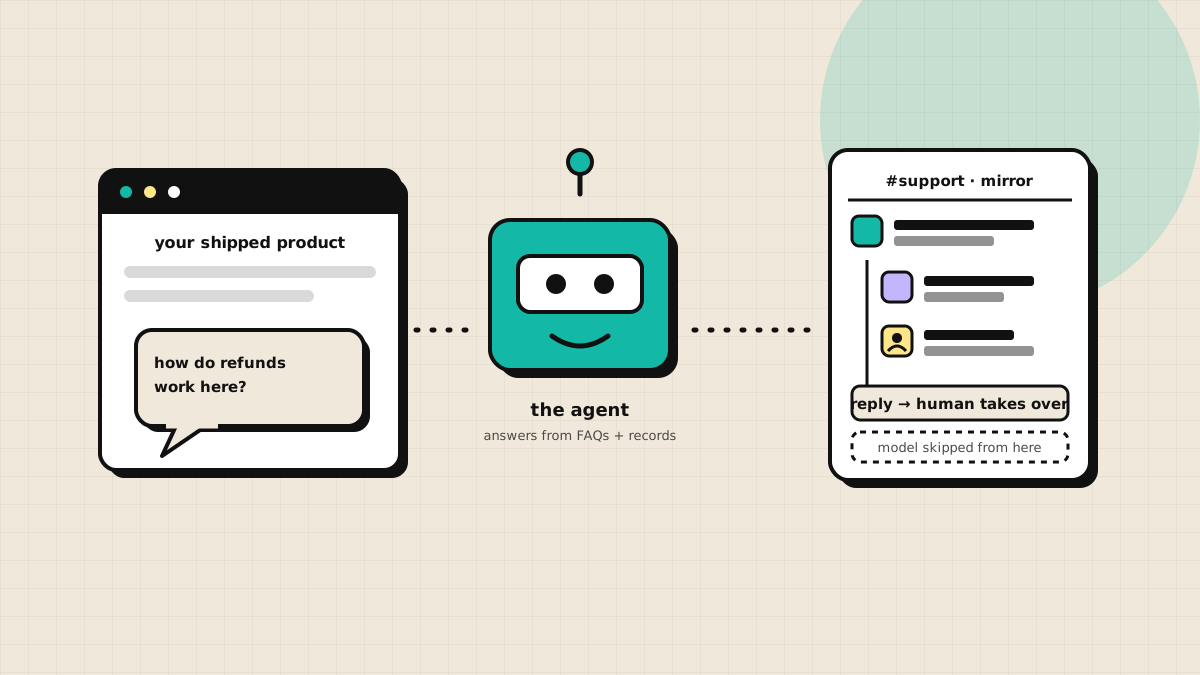
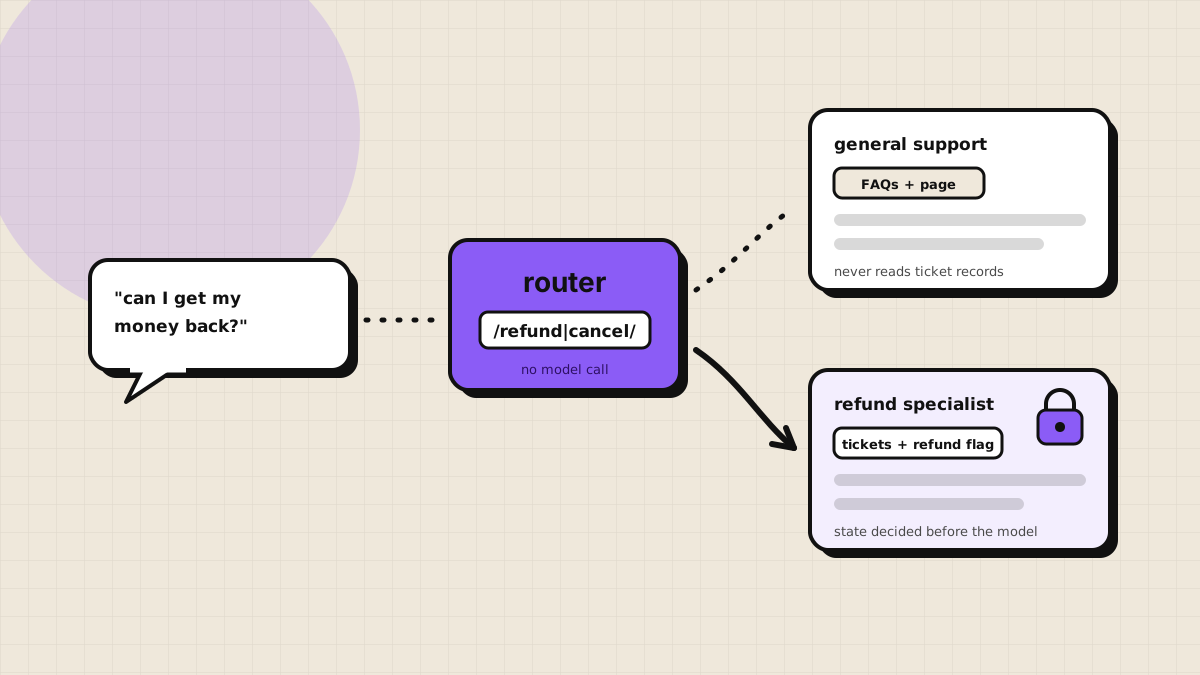
The approval card is one touchpoint of a larger loop: humans also need visibility (every agent action in a channel or log humans actually read), interruption (a way to take a conversation or workflow away from the agent instantly — the support-bot version of this is a hard short-circuit), and the last word (an agent that cannot do something should say exactly where the human can — the one real link, not an invented workaround).
How I implemented it on a real project
The events platform I work on lets hosts operate their events from Claude or ChatGPT through an MCP connector. Those tools include consequential writes — create, publish, tickets, refund policy, delete — so the guardrail stack above is not theoretical here. The scopes and gateway validation were inherited from the public API. The piece built specifically for agents is the confirmation gate.
One gate function, two ways to say yes
Every mutating tool passes through a confirmWrite function before touching the API. If the chat client supports elicitation, the server raises an approval card in the thread — the action, its details, a confirm field — and proceeds only when the person accepts. Decline or dismiss means nothing was written. If the client cannot render cards (or the card errors), the tool returns without writing and tells the model to state the action and call again with an explicit confirm flag — the two-call protocol, as a fallback rather than a default. Try the combinations:
What it takes to say yes — try it
the write
the chat client
An approval card appears in the chat
The action and its details are shown. Only an explicit accept lets the write run. Decline or dismiss, and nothing changed.
Destructive writes refuse the fallback
Deletes that remove saved records set a stricter flag on the gate. There, the model's own confirm flag is ignored, auto-approval grants are ignored, and if the client cannot show the card, the tool stops and points the person at the product's own editor. I wanted that branch to be boring: an agent that can delete because it said it was sure is not a confirmation system. The deliberate cost: users on card-less clients cannot delete through chat at all. That trade — a missing convenience for a missing catastrophe — took zero debate.
The rules that survive a yes
Even confirmed, the tools enforce the platform's point-of-no-return rules, and the server instructions tell the model not to dodge them:
What stays locked after go-live
Refunds are a ratchet
Before go-live the policy is confirmed with the host. Once live, refunds can be turned on — never off.
A live free event stays free
It cannot be converted to ticketed after publish. The assistant is told to explain the refusal, not engineer around it.
Delete is not a workaround
Recreating the event to escape a locked setting is explicitly forbidden. Close and delete run only when the host asked for that event.
Payment handles stay out of chat
Paid tickets require a connected payment method first. The assistant hands over the connect link and waits — it never collects a handle in the conversation.
A new event is a draft, and publish requires a description, location, and date — asked for, never invented. Refund policy is confirmed with the host before go-live; after go-live it can be turned on but never off. A live free event cannot become ticketed. And — written in plain language because models genuinely attempt it — deleting or recreating the event is not an acceptable workaround for any refusal. Payment setup has its own stop: the agent never collects payment handles in chat; it hands over the connect link and waits.
What this cost and what it bought
The gate added one function, a flag, and some instruction text — small engineering. What it bought is the property this whole guide is about: the worst plausible action of a model with write access to live events is now a refused call or an unapproved card, both visible, both recoverable, both logged. There is no measured "cost of production-readiness" figure to cite — the honest accounting is that the gate took days, and the incidents it prevents are the kind that end the feature.
Pitfalls to avoid
- The
confirmed: trueshortcut as the default path. The model will set it. Use client-side approval where it exists; treat the flag as a stated-intention fallback only. - Blanket approval ("yes to everything this session"). Approval that persists is approval that gets inherited by an action nobody foresaw.
- Guardrails only in the prompt. Instructions make refusals legible; the API makes them real. You need both, in that order of trust.
- Confirming reads. Gate consequence, not everything — an agent that asks permission to list events trains users to click yes reflexively, which is its own vulnerability.
- No kill switch. The day something loops, you want a flag that stops agent writes without a deploy.
FAQ
For reads and drafts, the agent runs free — that is most of the volume. The yes is reserved for consequence. Users lose seconds at exactly the moments they would want to be asked, and the agent keeps its value everywhere else.

Written by
Rushit Jivani
Senior Software Architect & AI Application Engineer. Architecture that shows up in crash rate, performance and how fast the team ships.